
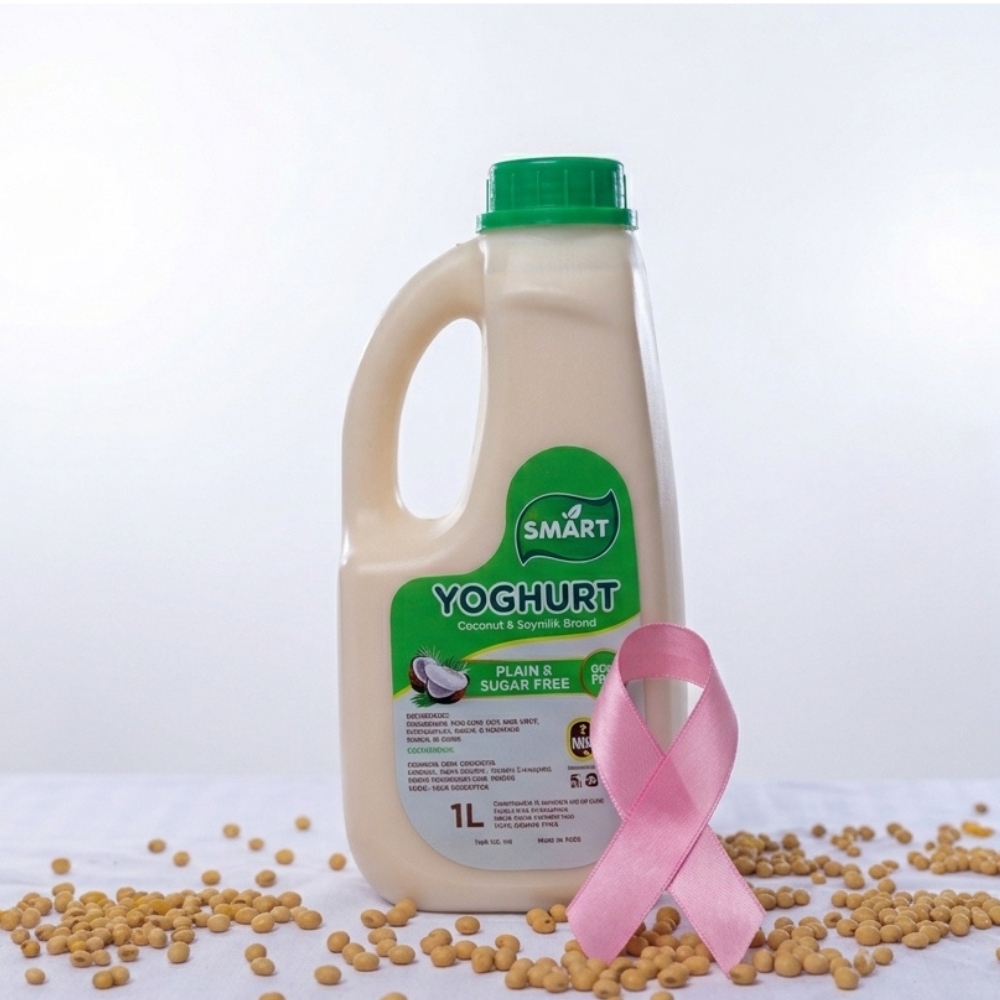
Across East Asia, countries like China and Japan have consumed whole, fermented soy products—such as tofu and soy milk—for thousands of generations. In these regions, traditional soy foods are deeply woven into the rich fabric of cultural heritage and daily life.
It so happens that populations in these countries have consistently recorded some of the lowest rates of breast cancer in the world.
Here is why. Researchers conducted landmark population tracking studies, including The Shanghai Women’s Health Study, which followed over 70,000 women over many years. It revealed that women who regularly ate whole soy foods faced no increased breast cancer risks. In fact, those who consumed whole soy consistently showed significantly lower rates of breast cancer and better overall survival outcomes.
For food scientist Martin Ssali, founder of Smart Foods Uganda, such global studies form a powerful foundation for their mission. They reinforce the fact that whole soy products—like Smart Yoghurt and Smart Tofu—are a vital, natural tool in protecting breast health.
To appreciate why whole soy provides such a powerful protective effect, we have to look at how estrogen and plant compounds actually interact inside human cells.
Estrogen is a natural hormone produced mainly in the ovaries. As the primary female sex hormone, it is responsible for reproductive development and normal tissue growth—including signaling breast cells to grow and divide as part of the body’s natural health cycle.
When a cell mutates and becomes cancerous, natural human estrogen can act as fuel—telling those mutated cells to multiply, feeding the tumor, and causing it to grow faster.
To picture how this works, imagine breast cells covered in tiny parking slots. Human estrogen travels through the bloodstream like a car looking for a place to park. When it pulls into one of these slots, it turns on a switch that signals the cell to grow and divide—even when some of those cells are cancerous.
However, when discussing breast cancer, a crucial scientific distinction must be made: estrogen does not transform a healthy cell into a cancerous one. Instead, it acts as an accelerator, signaling cells that have already mutated to divide and multiply.
Now we enter the power of fermented, whole soy. Soy naturally contains plant compounds called phytoestrogens (specifically, isoflavones). Unlike natural human estrogen, soy phytoestrogens have an antagonistic effect when interacting with breast tissue. In short, an antagonistic effect means soy phytoestrogens actively counter human estrogen by taking up space on the cell without triggering growth.
Think of breast cells as having specific parking slots (estrogen receptors). When natural human estrogen pulls into that slot, it turns the engine on and accelerates cell division.
Soy phytoestrogens, however, pull into that same parking slot and turn the engine off. Meaning, instead of accelerating growth, plant estrogen acts as a protective shield—blocking the fuel supply to mutated cells and preventing potential tumor progression.
A question can come to your mind: If soy modulates estrogen, does it affect the normal growth of breasts in adolescent girls? The science shows the exact opposite—girls who regularly consume whole soy from childhood actually gain a far stronger protective effect against breast cancer later in life. When a breast cell behaves abnormally or becomes cancerous, that is when soy isoflavones step in to antagonize that cell’s growth.
Making whole soy a part of your daily meals is a simple, delicious way to nourish your body and actively protect your breast health. Choose Smart Yoghurt and Smart Tofu for your family today. Available at major supermarkets across Uganda—including Mega Standard, Carrefour, Capital Shoppers, Quality, TMT, and Ecomart. For direct orders or delivery enquiries, call or WhatsApp: +256702285608.
(In Part 2 next week, we debunk the biggest myths surrounding soy and health.)
Leave a Reply