
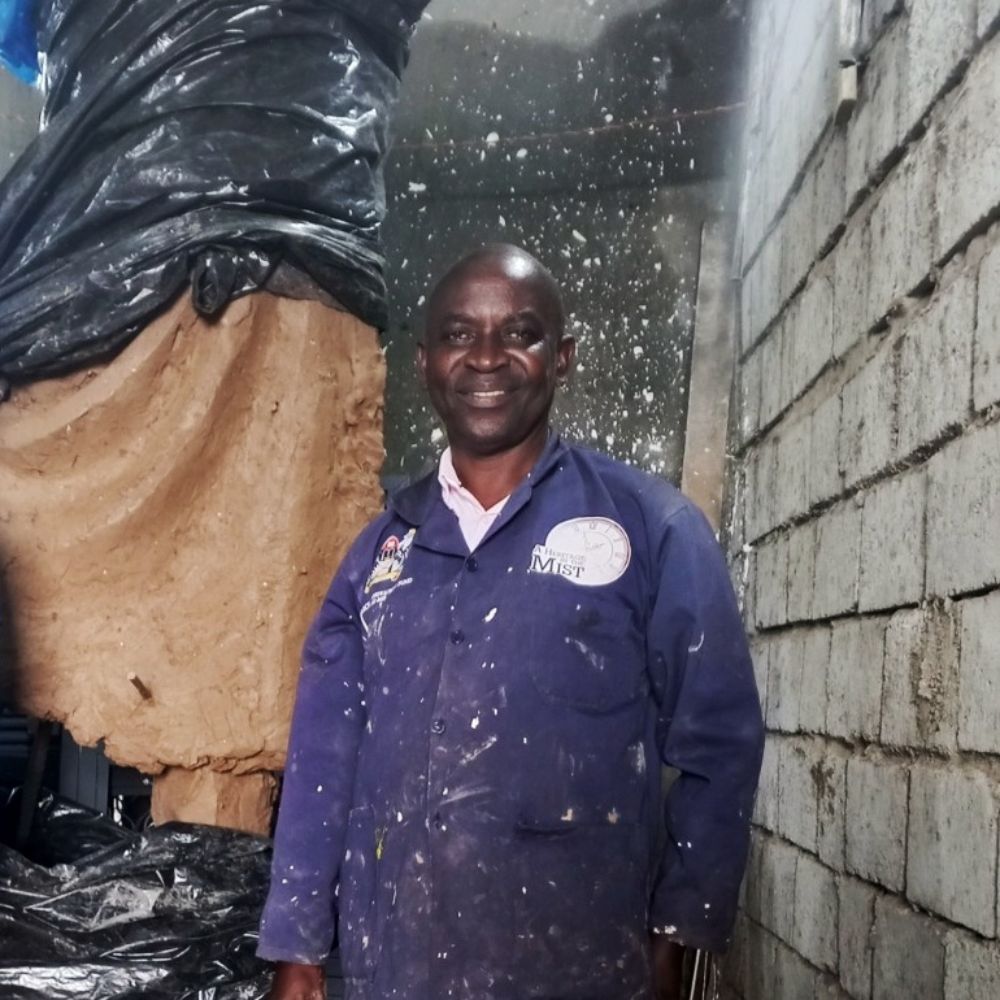
Kyanamukaka, a place in Masaka District, central Uganda, has gained prominence because of the people who call it home, like former Vice President Edward Sekandi. It is here, in the village of Butoozi, that Professor George William Kyeyune hails from.
Born in 1962 and raised in a family grounded in Catholic values, his father prioritized education working tirelessly to ensure all his children received an education at a time when such a commitment was rare.
Sundays were dedicated to church, while weekdays meant a six-kilometer trek to school—made entirely barefoot. Shoes were scarce, yet the long walk was far from lonely; shared with friends, it was full of laughter and life.
Back then, having a TV in the home was a major luxury. Their household was fortunate enough to have a small 14-inch black-and-white screen, powered entirely by a car battery that lasted just one week before needing a recharge from another town. The other great source of entertainment was football. Where standard balls weren’t available, they made their own from banana fiber—and they were surprisingly effective.
Teaching and public service ran deep through the family tree. His grandfather and mother were both teachers, and his father eventually rose from being a teacher to become Under Secretary for the Ministry of Tourism. In the Kyeyune home, education was always the top priority.
Life as a student was smooth and steady. George was an average student who never failed, but he wasn’t necessarily at the top of the class. By Senior One, Art had become his favorite subject. However, the realization of his gift started much earlier, on a canvas provided by nature.
Whenever it rained, while the compound soil was still heavy and moist, the earth itself became his very first canvas. With sticks and his own fingers, George drew pictures in the ground. For most children, it was merely play. But for young George, it was a quiet moment of revelation.
It serves as a gentle reminder of why a child’s early curiosities matter. So often, what we pass off as simple play is actually talent making its initial, quiet appearance.
Drawing on the soil was an instinct he could not yet explain. Long before he knew what art was, those soil sketches were pure instinct—an effortless way to express life as he felt it. But his actual journey into professional art was shaped by two uncles: one who was teaching art at the University of Nairobi, and another at Makerere University.
George greatly admired his uncles, but in his heart, he wanted something more. Teaching art was fine, yet his real desire was to create art. The spark that turned that desire into a raging fire arrived in a small bundle from Rome: postcards brought by his grandfather after a sacred pilgrimage.
Holding those postcards of the Sistine Chapel, George saw art in a whole new light. Michelangelo’s precision with human form and the depth of emotion in his figures fascinated him. In those tiny images, he caught a glimpse of what art could truly achieve, and there was no turning back.
That inspiration stayed with him, and before long, he became the standout art student in his school, earning widespread admiration. But even with his gift on full display, George could not escape the classic family expectation. A relative persuaded him to pursue the sciences in A-Level so he could become the family’s first doctor. Out of respect and obedience, he enrolled in Biology, Chemistry, and Geography, keeping Art only as a fourth principal.
Looking back, he admits it wasn’t the smartest move, but it proved to be a blessing in disguise. He didn’t pass the sciences well, which allowed him to apply for Art as his first choice at university. In 1982, he learned he was first on the list for Government Sponsorship to Makerere University to study art.
In the 1970s and 80s, many opted for business over further education, seeking immediate returns by trading coffee for merchandise. It was a period characterized by magendo (black market) due to the scarcity of many essential goods, offering the lure of quick gains.
But George stayed the course, driven by the benefits of education he saw in his parents. With no landed property to inherit, he knew education was his only way to secure the future.
That belief paid off sooner than expected. During his vacation, he was commissioned to paint a portrait of President Milton Obote for a fundraising event at Christ the King Secondary School. When he was paid for his work, it was enough to buy a cassette recorder. In those days, owning one was the ultimate mark of distinction for any young person.
Then during his second year at Makerere University, he secured an internship at Associated Creative Designers (ACD). Working there, he earned his first real commercial money from art. He used it to buy a radio cassette player: a major upgrade from his simple cassette recorder, and proof that his talent was opening real doors.
While others believed the stereotype that one couldn’t live off art, George looked at figures like John Nagenda and saw a different reality. Nagenda was a prolific writer who had made both a name and a comfortable living purely from his talent. Guided by that example, George held a simple, grounding faith: there were very few good artists in the world, and he fully counted himself among them.
That belief pushed him to give his very best. He graduated with a First Class degree in Painting and Sculpture from Makerere University, but he wasn’t done learning. He secured a one-year scholarship for a Master’s degree at the Maharaja Sayajirao University of Baroda in India.
His hard work during that fellowship so impressed his professor that he was offered full funding for a second year. To cover the remaining costs, he held an art exhibition in Bombay, selling enough pieces to fund his degree to completion.
He returned to Uganda in 1990 and secured a job teaching at Makerere University. Soon after, he earned a Commonwealth Scholarship to pursue his PhD at the University of London (SOAS). This marked a pivotal transition in his career as he shifted from the studio to the pen. His thesis, Art in Uganda in the Last Century, is now in the final stages of becoming a published book.
For the Professor, the academic journey was never laborious because it was fueled by love. He navigated the complexities of international curricula and the transition to writing with the same natural ease he once used to draw in the Masaka soil.
Today, years later, Professor Kyeyune’s work remains among the most distinguished in the country. His major public monuments include The Journey, created for Uganda’s 50th Independence anniversary at Kololo Grounds, and the iconic CHOGM Monument near the Parliamentary Building in Kampala, among many others.
Yet perhaps the greatest of them all for him is the Mother of Martyrdom monument at Munyonyo, honoring St. Andrew Kaggwa and the martyrs before their final trek to Namugongo. Being a devout Catholic, this commission brought a moment of profound personal grace: the opportunity to meet Pope Francis. It remains the highest point of his career—where his faith, his country’s history, and his artistic mastery met in a single, sacred space.

Beyond his public monuments in bronze and copper, Professor Kyeyune also works extensively on canvas. Using a palette knife to apply thick layers of oil paint, he captures the everyday life and routines of ordinary Ugandans. To view a selection of these paintings, readers can explore his Ordinary Lives Portfolio featured on The Weganda Review.
For all his major public commissions and academic honors, his ultimate desire remains deeply humble: to return to Butoozi, to a quiet three-bedroom house where he can simply sit back and watch the world pass by. It is a fitting dream for a boy who began by tracing figures in the Masaka soil.
Having shaped the visual landscape of his country and recorded its artistic history for generations to come, Professor Kyeyune’s legacy is firmly anchored. Yet at his core, George William Kyeyune remains an artist driven by quiet observation, steady faith, and an enduring love for the craft.
“Without art, I feel asphyxiated!” he admits.
Indeed, this is the story of a man for whom art was always in his heart—and it has been a true privilege for us at Lapatutu to capture his journey.

Leave a Reply