
The Uganda Wildlife Conservation Education Centre (UWEC) is still widely known as the Entebbe Zoo. While that label is common, there is a fundamental difference. A traditional zoo is built primarily for entertainment. UWEC, while offering leisure, focuses heavily on wildlife education and active conservation—covering both animals and plant life.
That brings us to a second critical point. When most people hear the word “wildlife,” they immediately picture animals: lions, elephants, or buffaloes. But wildlife also includes the plant systems that sustain them.Simply put, without these plant systems, animals like monkeys and elephants would have no food or shelter.
Interestingly, many of these same plant species also hold significant medicinal value for humans. A prime example is Warburgia ugandensis (locally known as Mukuzza nnume), which served as a key active component in Professor Ogwang’s Covidex formulation.
This reinforces a crucial truth: tree planting benefits both people and wildlife. You likely understand this importance and may even want to plant trees yourself, but like many today, a key challenge can be finding space due to limited land in modern residential areas.
How do you bridge the gap between wanting to plant trees and having a place to put them?
UWEC provides a direct answer.
In addition to the standard entrance fee, you can purchase a tree seedling starting at just 10,000 UGX and plant it directly on their grounds in Entebbe. This provides a practical solution for anyone looking for space to plant: you get a designated spot on the sanctuary grounds, allowing you to enjoy a day at UWEC while actively restoring the food and habitat the animals rely on.
Imagine the joy of returning ten years from now to see a mature tree you planted growing alongside the wildlife.
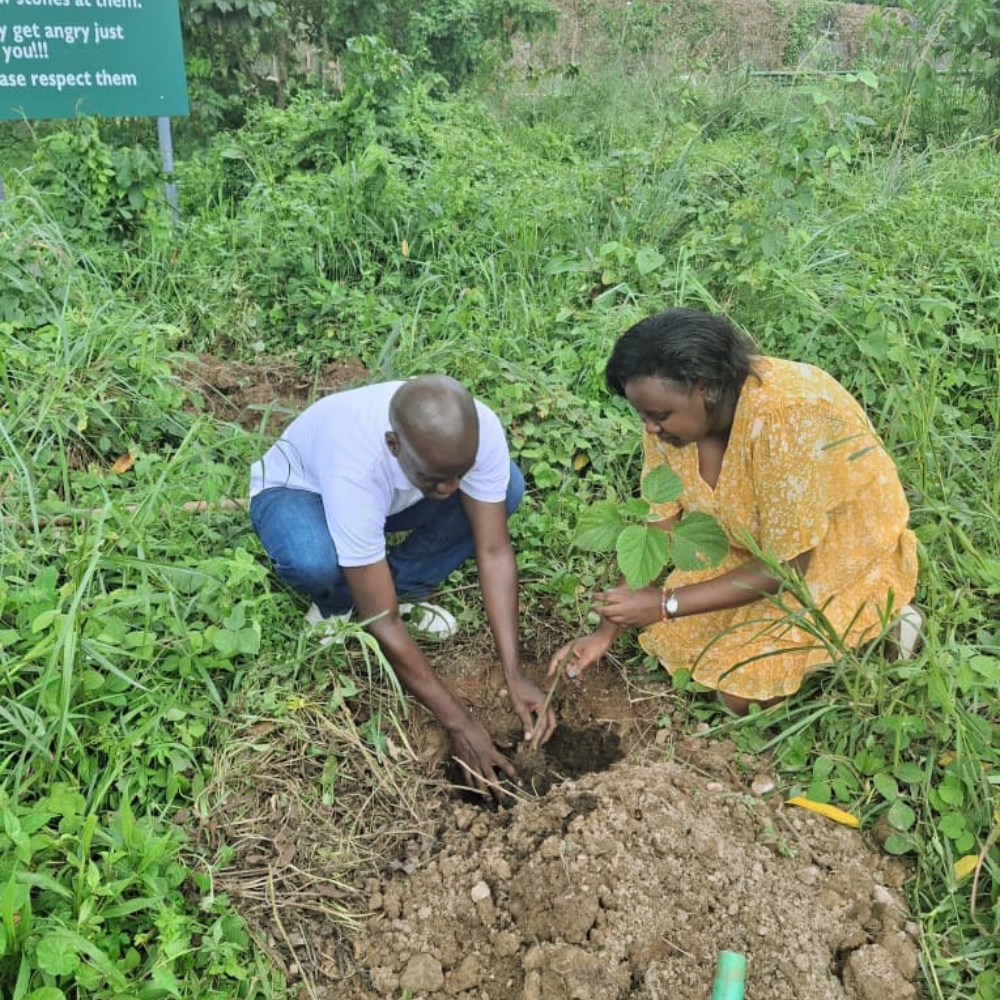
Earlier this year, our team at Lapatutu had the privilege of planting some trees at UWEC. Planting a small seedling into the ground that will eventually form part of a canopy aligns directly with how we view legacy: doing something today to benefit future generations. It is much like our writing—we amplify stories to ensure they hold strength and clarity so their value endures well into the future.
Our visit was guided by Ms. Atukwase Ritah Bagaba, a botanist at the Uganda Wildlife Authority. Holding a Master’s in Botany, her deep expertise showed us that botany for her is not just a career path, but a dedicated passion.

She highlighted a vital principle that is often overlooked: true conservation isn’t just about planting trees, but planting the right trees. She emphasized prioritizing indigenous species over invasive ones, taking into account their ecological role and medicinal value.
We had the opportunity to plant several key indigenous species, including Warburgia ugandensis (locally known as Mukuzza nnume), Albizia coriaria (Omugavu), and Prunus africana (Entasesa). It was an honor being a part of something bigger than ourselves.
The next time you visit UWEC, take the opportunity to plant a tree—or even one for each member of your family. It is a simple step that lets you enjoy the wildlife today while building a living piece of the story for the future.


Leave a Reply